What AKC registration actually guarantees (Hint: not health)
A breeder hands a new owner a folder. Inside is an AKC registration certificate, and on the strength of that one piece of paper, the buyer relaxes. Registered dog. Real breed. Must be a healthy, well-bred puppy.
Here's the uncomfortable part: that certificate didn't promise any of that. It never claimed to.
If you breed dogs, you already half-know this. But most of your buyers don't — and the gap between what they think registration means and what it actually means is exactly where trust gets won or lost. So let's say it plainly. What does AKC registration actually guarantee, and what does it leave entirely up to you?
What the papers do prove
AKC registration certifies two things. Your puppy's parents were registered with the AKC as the same breed, and the litter was recorded. That's it. That's the whole transaction.
The AKC says so itself. In its own words, a registration certificate "in no way indicates the quality or state of health of the dog." Registration is a lineage record — a family tree with a logo. It documents who the parents were. It doesn't examine the dog.
That distinction matters more than most buyers realize. The registry works off the paperwork a breeder submits. Its DNA programs verify parentage — that the sire and dam are who the application says they are — not whether either dog is sound, screened, or fit to breed. The pedigree gets checked. The dog doesn't.
What registration can't tell you
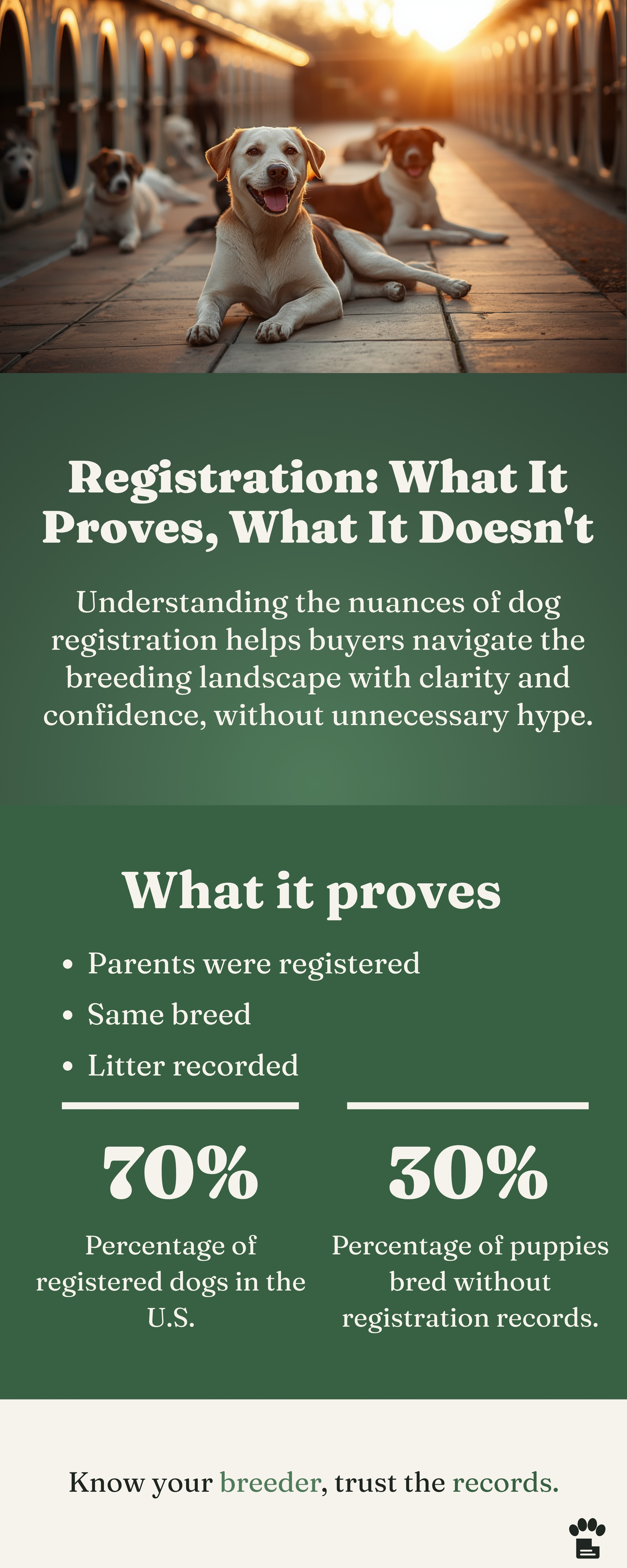
Once you understand that registration is a parentage record, the list of things it can't promise writes itself:
- Health. No hip score, no elbow grade, no cardiac or eye clearance, no genetic panel. None of it is required to register a dog or a litter.
- Temperament. The registry never meets the dog. Steady, sharp, soft, or nervous — they all register exactly the same.
- Quality. A dog that misses its breed standard on size, structure, or coat registers right alongside a national champion. Same paper.
- Breeding ethics. A puppy mill files the same litter application a careful hobby breeder does. The form doesn't ask how the dogs were raised, and nobody comes to look.
The only real gate on breeding an AKC-registered dog is age — it has to be at least eight months old. There's no health bar to clear. That isn't a loophole; it's the design. A lineage registry records ancestry. Asking it to certify health is like asking a birth certificate to certify a clean bill of health — wrong document.
To be fair: what the papers are good for
None of this makes registration worthless, and any breeder who tells a buyer it is has overplayed the hand. A clean pedigree is genuinely useful. It documents ancestry in a standardized form, which matters when you're tracking a line across generations. It's the ticket into conformation and most AKC performance events — agility, obedience, field, the rest. It gives the whole sport a common language for who came from whom.
What registration isn't is a substitute for health testing, temperament evaluation, or due diligence on the breeder. It's a foundation, not a finish line. The mistake isn't getting papers. The mistake is treating papers as the answer to a question they were never built to answer.
The AKC quietly admits the gap
Here's the tell. If plain registration proved a dog was healthy and well-bred, the AKC wouldn't need to sell anything extra on top of it. But it does.
Programs like Bred with H.E.A.R.T. and Breeder of Merit exist precisely because base registration says nothing about health or breeding practice. Those programs layer on health-testing requirements, continuing education, and — for Bred with H.E.A.R.T. — a signed agreement to follow recommended screening and submit to inspection. They're the AKC's way of bolting a health signal onto a system that doesn't carry one by default.
Read that again. The registry built a separate badge to communicate the exact thing buyers wrongly assume registration already covers. The papers don't prove health. The add-on programs are the proof that the papers don't.
What the gap costs you
This isn't an academic point. It hits a working program in three places.
Your buyers are catching on. "AKC registered" used to close a sale by itself. It doesn't anymore. A two-minute search tells any prospective buyer that papers and health are two different things, and the better-informed ones now ask about clearances before they ask about price. If your listing leans on registration and goes quiet on testing, you read like everyone else.
You carry the proof burden separately. Because registration won't vouch for your dogs' health, you have to — with OFA results, Embark reports, photos, and contracts you assemble and store yourself. For most breeders that means a registry, a spreadsheet, a website, and a folder that never quite agree with each other.
You compete against papers that mean nothing. The backyard breeder down the road puts the same three letters on their listing that you put on yours. To a buyer who still thinks registration equals quality, you look identical — right up until you can show what they can't.
What real proof looks like
If registration isn't the proof, what is? Verifiable, third-party health testing — the kind a buyer can confirm without taking your word for it.
- OFA (Orthopedic Foundation for Animals). Evaluations for hips and elbows, plus cardiac and CAER eye exams. Final hip and elbow clearances are read at 24 months. Results post publicly at ofa.org, searchable by registered name or number — meaning a buyer can verify them in about a minute.
- CHIC (Canine Health Information Center). A CHIC number means a dog completed every health test its breed's parent club requires and the results were made public. Worth knowing: CHIC certifies that the testing was done and disclosed, not that the dog passed everything. The transparency is the point.
- Embark. A DNA panel screening 270-plus genetic health conditions and confirming genetic diversity. Many results are accepted by OFA, and the report is something a buyer can actually read for themselves.
Notice the thread running through all three: independent, documented, and checkable. That's what separates a claim from a guarantee. Registration is a claim about ancestry. Health testing is a guarantee a buyer can verify.
A registry built on proof
This is the gap PetRecords was built to close.
Our registry doesn't pretend a pedigree is a health certificate. It ties recognition to what's actually on file. The badge tiers — Bronze, Silver, Gold, Platinum — report what a dog's record documents: care reviewed, health and genetic testing on file, OFA confirmed. A tier isn't marketing copy. It's a readout of the paperwork behind the dog.
We keep two things separate that other registries blur together. Registration means a dog is in the system. Verification means its testing has been reviewed. A Bronze registration is an honest entry point — in the registry, not yet verified — and we say so, because calling an unverified dog "verified" is exactly the rot we're trying to fix.
The economics are flat and stated without hedging. Every registration is $35, every tier, with no transfer fees and no late fees. A duplicate certificate is $15. A registration follows the dog from family to family, forever, at no extra cost — because a dog's record should outlive the transaction that created it. The door's open, too: any dog can enter on AKC-stock lineage or an Embark genetic test. The entry is open; the standard is earned.
That's the whole idea. Registration should mean something a buyer can check. Until the paper proves the dog — not just the parents — the proof is on you. We'd rather build it in.
Register a dog — $35, flat. View the registry →